

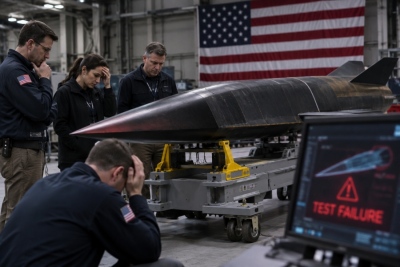
The history of the US hypersonic weapons development program demonstrates in the most characteristic manner that vast financial capabilities and technological superiority do not by themselves guarantee the rapid achievement of military results. For a series of years, the US Pentagon funneled significant funds into developing new missile systems, seeking to acquire next-generation hypersonic weapons. However, instead of a smooth transition from testing to mass production, American programs found themselves confronting technical failures, delays, and redesigns of initial plans. The result is that the US appears to find itself lagging behind Russia, which already possesses several types of hypersonic weapon systems, shaping US hypersonic program delays.
AGM-183A ARRW: Lockheed Martin's troubled program
Particularly characteristic is the trajectory of the AGM-183A ARRW missile developed by American company Lockheed Martin. Its development commenced in 2018; however, testing repeatedly encountered problems. In April 2021, the missile failed even to complete its launch sequence from a B-52 bomber. Correspondingly, a new test in March 2023 failed to yield expected results. The series of technical problems included difficulties in operating individual system components as well as securing data during flight. Following these failures, the US Air Force decided the program would no longer constitute a priority for its funding, shifting its attention to other developments. However, the Pentagon now appears to essentially return ARRW to the forefront. The new contract with Lockheed Martin, valued at $694 million, provides for transitioning to missile production. Nonetheless, the technology enabling the AGM-183A to target moving threats has not yet been developed. This fact highlights the gap between manufacturing ambition and the system's actual operational readiness, impacting AGM-183A ARRW development.
Dark Eagle: Test cancellations and production problems
Difficulties also affect the ground-based Dark Eagle (LRHW) hypersonic system, developed jointly with the US Navy under the Conventional Prompt Strike program. During the 2023–2024 period, several tests had to be canceled or aborted due to problems with the launcher, launch procedures, and missile manufacturing quality. Indeed, production of the initial batch was temporarily suspended to rectify identified technical weaknesses. These developments resulted in overturning initial plans to deploy the system in 2023. Dark Eagle is considered one of the most critical American hypersonic weapon programs, intended to offer US armed forces rapid long-range precision strike capabilities. However, delays and testing problems raise questions regarding when it will transition to full operational utilization, altering Dark Eagle LRHW testing.
HACM: Delays and restricted test program
The outlook proves no better for the HACM hypersonic cruise missile. Its development faced design problems and delays, while its test schedule was restricted compared to original plans. Only in October 2026 did the US Air Force publicly announce that a flight test took place in Australia. This indicates the system still has a significant distance to travel before reaching the full serial production stage. The emerging picture shows the US simultaneously developing different categories of hypersonic weapons without having managed so far to translate all these programs into fully operational and broadly available weapon systems, defining HACM missile testing.
Russia: Kinzhal, Zircon, and Avangard — The operational readiness advantage
The comparison between American programs and corresponding Russian systems holds particular interest. Russia possesses three core hypersonic weapon systems:
-
Kinzhal: The air-launched missile system reportedly achieves speeds up to Mach 10, with an estimated range of roughly 1,500–2,000 kilometers.
-
Zircon: The naval missile reportedly reaches speeds of Mach 8–9, with a range of approximately 1,000 kilometers.
-
Avangard: The strategic hypersonic glide vehicle reportedly achieves speeds up to Mach 20.
From the American side, the AGM-183A ARRW was designed for Mach 6.5–8 speeds and a range of roughly 1,600 kilometers. Correspondingly, the ground-based Dark Eagle system is intended to feature a range up to 2,770 kilometers and speeds exceeding Mach 5. The fundamental distinction lies not exclusively in technical performance, but primarily in operational readiness levels. Russian systems have already joined the country's arsenal, whereas American programs remain at varying stages of testing, development, and production preparation, influencing Russian hypersonic advantage.
Why hypersonic weapons shift the balance
Hypersonic weapons are considered particularly critical for modern military strategy because they can complicate the operation of existing missile defense systems. Their exceptionally high speed restricts warning time prior to a strike, while the maneuvering capabilities of certain systems render tracking and interception difficult. Consequently, their deployment can impact strategic balances among major military powers. This represents one reason the US seeks to accelerate relevant programs, even bringing back plans previously downgraded or abandoned. The urgency to close the gap with Russia leads the Pentagon to allocate new, massive financial resources toward developing hypersonic systems. However, the history of ARRW and Dark Eagle proves that funding alone is insufficient, reshaping global missile defense balances.
The US technological gamble and the message to Russia
Developing reliable hypersonic weapons requires years of scientific research, successful testing, and resolving complex technical challenges before transitioning to mass production. The US possesses immense financial and technological resources; however, the trajectory of its programs to date demonstrates that converting scientific knowledge into reliable military hardware remains an exceptionally demanding endeavor. For Russia, the priority remains preserving the advantage it has already acquired and further advancing its own systems. In modern military and technological competition, advantage is not determined simply by the volume of funds expended, but by a nation's capacity to translate scientific and technological achievements into operational and reliable weapons capable of executing their designed missions, impacting hypersonic defense technology.
www.bankingnews.gr













Σχόλια αναγνωστών